Bedtime Routine for Toddlers: Evidence-Based Guide
FableLab · July 14, 2026 · 12 min read
It's 8:40 p.m. and you're negotiating with a two-year-old about which side of the pillow is the correct side. Bedtime started an hour ago.
Here's the uncomfortable truth about what fixes this: nothing clever. What works is a boring sequence of three or four steps, run in the same order every single night. That's the whole intervention — and it's one of the best-studied in pediatric sleep. In a randomized trial with children aged 8–18 months, sleep improved measurably within the first three nights.
Why does something so plain work? Because a toddler can't read a clock and won't take "it's late" on faith. The sequence is the clock. Bath predicts book, book predicts cuddle, cuddle predicts lights-out — and a brain that knows what's coming stops fighting it. Every piece of advice in this guide is that one idea, calibrated: to your child's age, to the nights it breaks, and to the rare cases a routine can't fix.
Why Toddlers Need a Routine: The Sleep Math at 1–3
Start with the size of the job. The American Academy of Sleep Medicine — in a consensus endorsed by the American Academy of Pediatrics — recommends that children aged 1 to 2 sleep "11 to 14 hours per 24 hours (including naps)"; by ages 3 to 5, the range slides to 10 to 13.
Note the parenthesis: it's a 24-hour total, naps included. If your toddler naps two hours at daycare, the overnight target is closer to 9 to 12 — which means bedtime is arithmetic, not vibes. Count backwards from tomorrow's wake-up, not forwards from "they seem tired." Hitting that budget is tied, in the same consensus, to better attention, learning, memory, and emotional regulation; missing it, to attention and behavior problems.
That's a lot riding on a slot of the evening most families improvise. And most families struggle with it — by the Sleep Foundation's summary, as many as 20 to 30% of babies and toddlers have trouble sleeping. You can't control how fast your child's brain matures. The routine is the lever you do control.
The 30-Minute Wind-Down: Anatomy of a Working Bedtime
Strip the published bedtime-routine studies down to their parts and the same four ingredients keep appearing. Jodi Mindell and Ariel Williamson's 2018 review names the domains: nutrition, hygiene, communication, physical contact. In an actual hallway at 8 p.m., that's:
- Snack — something small and boring (nutrition)
- Bath or wash, teeth, pajamas — the day is visibly ending (hygiene)
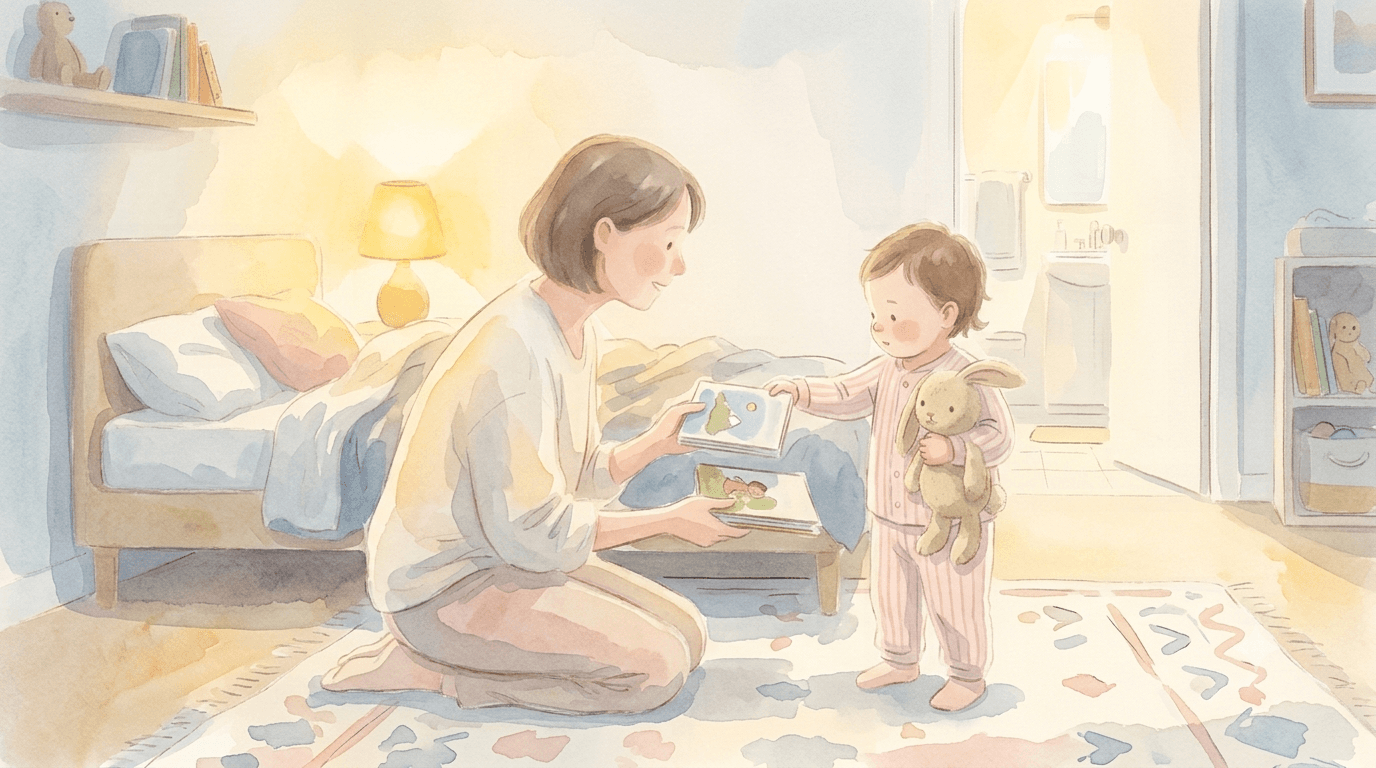
- Book — same spot, lamp on (communication)
- Cuddle and a goodnight phrase — the same words every night (physical contact)
Three or four steps, about half an hour, per Sleep Foundation guidance — and always in the same order. The order is yours to choose; the invariant is that it stops changing. Remember the mechanism: the sequence is the clock. A routine that's assembled differently each night tells the child nothing about what comes next, which is to say it isn't a routine.
The exit ramp matters as much as the steps: leave while your child is drowsy but still awake. A child who does the last stretch of falling asleep alone doesn't panic on surfacing at 2 a.m. to find you gone — the wake-up is a repeat, not a betrayal.
And this isn't folk wisdom that happens to sound tidy. Mindell's 2009 randomized trial, run on children 7 to 36 months — exactly this age band — found significant improvements in how fast children fell asleep and how often they woke. Making the sequence survive real weeknights is its own skill, covered in how to build a bedtime reading routine that sticks.
Ages 12–18 Months: The Simplest Version
At this age the routine is at its shortest and most physical: wash, pajamas, one short book or song, cuddle, crib. Three steps, twenty to thirty minutes. The "book" can be two minutes of pointing at pictures and naming animals — that counts in full. (A child crossing their first birthday is also sliding between sleep brackets, from the infant 12–16 hours toward the toddler 11–14. Night sleep does most of that work, but naps still contribute a real slice — so judge the 24-hour total, not the night alone.)
Here's the encouraging part. This is the exact age band from Mindell's 2017 randomized study: 134 mothers of children aged 8 to 18 months started a consistent routine, and the data showed "the most rapid change in the first three nights" — faster settling, fewer wakings, and bedtime that simply felt easier to the mothers. Gains kept accruing over two weeks, but the steep part of the curve came almost immediately.
Most parenting projects pay off in years. This one gives you feedback by Thursday.
Ages 18 Months–2 Years: Handling the Toddler "No"
Around 18 months, the child who used to drift through the routine discovers that "no" is a complete sentence. This isn't the routine failing — it's autonomy development arriving on schedule, and it clocks in at bedtime because that's where the day's last decisions live.
Don't meet it with force, and don't meet it by abandoning the structure. Meet it with choices inside the structure — the Sleep Foundation's specific advice for stalling tactics. The steps are not negotiable; the details are. Bath happens — but with the boat or the cup? Book happens — but this one or that one? Two options, both acceptable to you, either acceptable to them. The child gets a real decision; the sequence keeps its shape.
Two supporting moves. A comfort object earns its place now — separation anxiety peaks in this window, and a stuffed animal that's part of the sequence is one more thing that reliably comes next. And when a step triggers protest, shorten it rather than skip it: a skipped step costs the sequence its predictive power, and predictability is the entire mechanism.
Ages 2–3: When Language Enters the Routine
By two, the book-and-talk step stops being background music and starts doing double duty: it settles the child and builds language. The data here is unusually strong. Lauren Hale and colleagues tracked 4,274 children across 20 U.S. cities and found that language-based bedtime routines — reading, singing, storytelling — at age 3 predicted both longer nighttime sleep and stronger verbal scores at age 5, after adjusting for family background. More sleep now, stronger language later: a measured two-for-one.
What it looks like in practice: two or three sentences about the day, in the same slot every night. Stories with an actual arc — the attention span is there now. A page they "read" back to you from the pictures. And a fixed goodnight phrase, which is the verbal equivalent of the comfort object.
One honesty note, straight from the study's authors: the verified benefits are sleep and cognitive development — they found "little evidence of such a benefit for child behavior or health." The bedtime story is powerful. It is not a cure-all, and you shouldn't trust anyone who sells it as one.
Reading Inside the Routine: When, How Long, What Kind
If you keep only one communication step, make it the book. The American Academy of Pediatrics recommends shared reading "beginning at birth", and research defining the optimal bedtime routine for infants and preschool children (Kitsaras et al. 2018) includes "book reading and book sharing activities before sleep" as a named component — not an optional garnish.
When: late in the sequence — after hygiene, before the final cuddle. The calmest slot.
How long: five to ten minutes — the toddler bracket in our age-by-age reading guide, which has the full breakdown.
What kind: predictable and calm beats novel and thrilling. If your toddler demands the same book for the ninth consecutive night, that's fine — repetition at this age is how the material gets absorbed, not a rut.
The nightly friction point usually isn't the reading — it's the choosing. Standing at the shelf at 8:15 refereeing a book negotiation is exactly the decision load that erodes routines. A personalized story calibrated to the 1–3 bracket sidesteps it: the right length, the child's own name in it, fresh each night.
Sleep Regressions: Riding Them Out
Sooner or later a toddler who slept fine suddenly doesn't, and the internet will hand you a name for it: the 12-month regression, the 18-month regression, each with a promised duration. An honesty check: "sleep regression" is parent vocabulary, not a clinical diagnosis, and those confident timelines have no agreed definition behind them.
What's actually happening is more ordinary. Developmental leaps, molars, illness, travel, a schedule change — something jostles the system, sleep gets noisy while it recalibrates, and then it passes.
The playbook is almost aggressively boring: keep running the routine. Don't rebuild it, don't add steps, don't conclude it "stopped working." The routine didn't stop working — something else disrupted sleep, and the same predictability that built the pattern is what pulls it back. Recall the speed of the mechanism: in Mindell's randomized data, a consistent routine moved sleep within three nights. And a rough patch doesn't erase banked progress — as covered in the habit-science guide, missed nights don't break a routine.
If the disruption drags on for weeks with no identifiable cause, stop calling it a regression — read the next section.
Five Red Flags Worth a Pediatrician Check-In
A good routine fixes a lot. Part of running one well is knowing which problems are outside its jurisdiction. None of these are emergencies — they're "mention it at the next checkup" items.
1. Regular snoring. Most nights, not the occasional stuffy-nose week. The AAP's clinical guideline is blunt about the reporting gap: "Most children with OSAS snore; however, parents rarely mention this at physician visits." Pediatricians are formally instructed to ask; meet them halfway and bring it up first.
2. Pauses, gasps, or snorts in breathing during sleep. The companion sign to snoring — describe it exactly as you observe it.
3. Sleep totals far outside the range despite weeks of a consistent routine. The AASM's own instruction: parents concerned that a child is sleeping too little or too much should ask their healthcare provider to evaluate for a possible sleep disorder.
4. Extreme difficulty settling, every night, for weeks. Protest is normal; unvarying distress despite a stable routine is a pattern worth professional eyes.
5. Marked daytime changes — attention, mood, or behavior shifts that track with the bad nights.
The list isn't there to alarm you — it's there so the routine-fixable majority of bedtime problems don't blur together with the few that aren't.
The Routine Is the Container. The Story Fills It.
Three or four steps, same order, about thirty minutes, ending drowsy-but-awake — with a book in the calm slot near the end. Easy to describe, hard to run at 7:45 p.m. on a Tuesday.
FableLab handles the story step: a personalized tale with your child's name, calibrated to the 1–3 bracket and the five-to-ten-minute slot — fresh each night, so the shelf negotiation disappears from the sequence.
Try a personalized bedtime story for your toddler →
Frequently Asked Questions
What time should a toddler go to bed?
There's no single research-backed clock time. Work backwards: the AASM recommends 11 to 14 hours per 24 for ages 1–2, naps included. A toddler who naps two hours and wakes at 7 a.m. lands the budget with a bedtime between 7 and 9 p.m.
How long should a toddler bedtime routine take?
About half an hour, per Sleep Foundation guidance — three or four activities, always in the same order, a little longer if there's a bath. Longer isn't better: a routine that keeps sprawling is harder to run nightly, and nightly is the part that matters.
How quickly will a bedtime routine improve my toddler's sleep?
Faster than most parents expect. In a randomized study of 134 mothers of children aged 8–18 months, the biggest improvements arrived within the first three nights, with smaller gains over two weeks. Benefits scale with consistency — see how to build a bedtime reading routine that sticks.
Should reading be part of a toddler's bedtime routine?
Yes. The AAP recommends shared reading from birth, and a study of 4,274 children linked language-based bedtime routines at age 3 to longer sleep and stronger verbal scores at age 5. Five to ten minutes before lights-out is the toddler target — details in how long to read to your child before bed.
What if my toddler fights every step of the routine?
Keep the steps, negotiate the details: which pajamas, which of two books, which stuffed animal. Autonomy-testing at bedtime is developmentally on schedule around 18 months–2 years. Persistent distress rather than protest — every night, for weeks, despite a stable routine — is worth mentioning to your pediatrician.
References
- Paruthi S, Brooks LJ, D'Ambrosio C, et al. Recommended Amount of Sleep for Pediatric Populations: A Consensus Statement of the American Academy of Sleep Medicine. Journal of Clinical Sleep Medicine, 12(6):785–786, 2016. https://jcsm.aasm.org/doi/10.5664/jcsm.5866
- Mindell JA, Telofski LS, Wiegand B, Kurtz ES. A Nightly Bedtime Routine: Impact on Sleep in Young Children and Maternal Mood. Sleep, 32(5):599–606, May 2009. https://pmc.ncbi.nlm.nih.gov/articles/PMC2675894/
- Mindell JA, Li AM, Sadeh A, Kwon R, Goh DYT. Bedtime Routines for Young Children: A Dose-Dependent Association with Sleep Outcomes. Sleep, 38(5):717–722, May 2015. https://pmc.ncbi.nlm.nih.gov/articles/PMC4402657/
- Mindell JA, Leichman ES, Lee C, Williamson AA, Walters RM. Implementation of a nightly bedtime routine: How quickly do things improve? Infant Behavior & Development, 49:220–227, November 2017. https://europepmc.org/articles/PMC6587179
- Mindell JA, Williamson AA. Benefits of a bedtime routine in young children: Sleep, development, and beyond. Sleep Medicine Reviews, 40:93–108, 2018. https://pmc.ncbi.nlm.nih.gov/articles/PMC6587181/
- Hale L, Berger LM, LeBourgeois MK, Brooks-Gunn J. A longitudinal study of preschoolers' language-based bedtime routines, sleep duration, and well-being. Journal of Family Psychology, 25(3):423–433, June 2011. https://pmc.ncbi.nlm.nih.gov/articles/PMC3134391/
- Sleep Foundation. Bedtime Routines for Children. Updated July 2025. https://www.sleepfoundation.org/children-and-sleep/bedtime-routine
- Kitsaras G, Goodwin M, Allan J, Kelly MP, Pretty IA. Bedtime routines child wellbeing & development. BMC Public Health, 18:386, March 2018. https://bmcpublichealth.biomedcentral.com/articles/10.1186/s12889-018-5290-3
- American Academy of Pediatrics, Council on Early Childhood. Literacy Promotion: An Essential Component of Primary Care Pediatric Practice (Policy Statement). Pediatrics, 154(6):e2024069090, December 2024. https://publications.aap.org/pediatrics/article/154/6/e2024069090
- Marcus CL, Brooks LJ, Draper KA, et al.; American Academy of Pediatrics. Diagnosis and Management of Childhood Obstructive Sleep Apnea Syndrome (Clinical Practice Guideline). Pediatrics, 130(3):576–584, September 2012. https://publications.aap.org/pediatrics/article/130/3/576/30284/Diagnosis-and-Management-of-Childhood-Obstructive